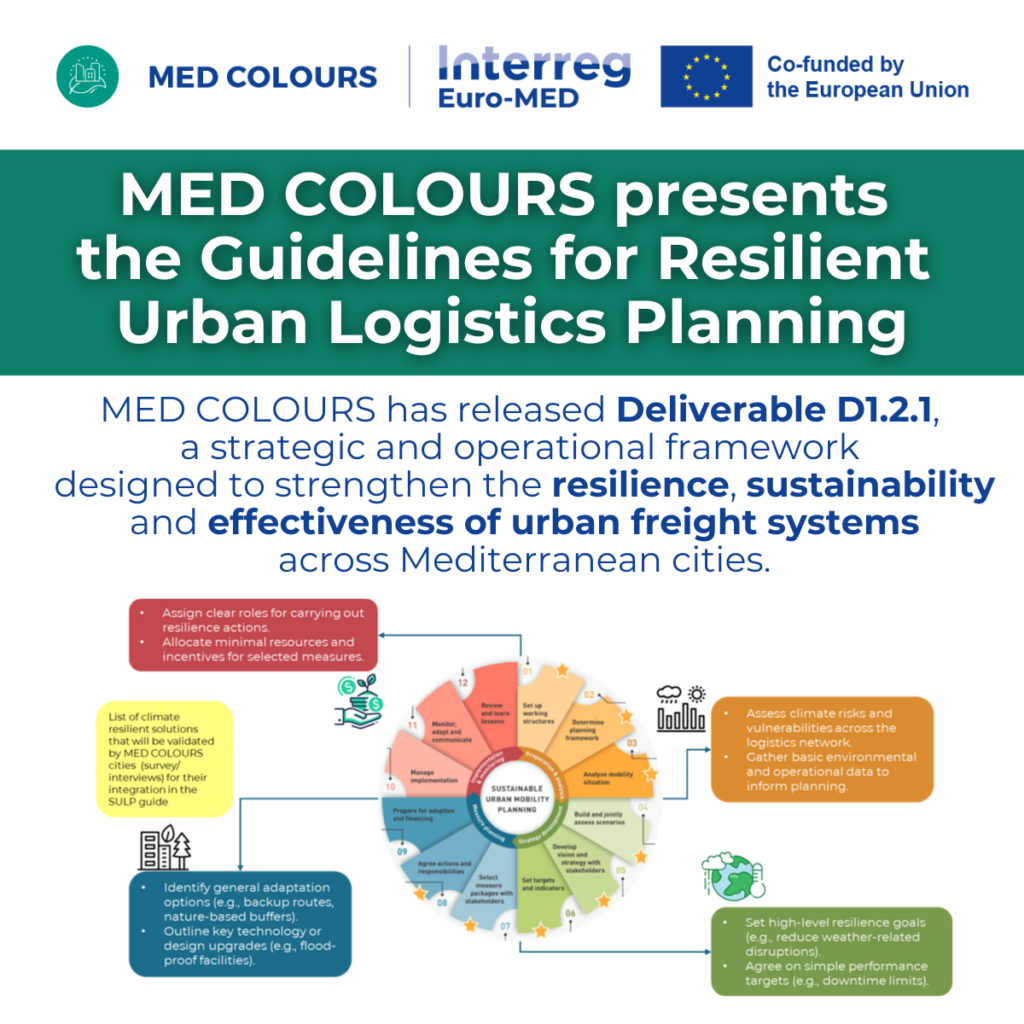
Urban freight is essential to the everyday functioning of Mediterranean cities, yet it is increasingly exposed to climate impacts, disruptions and rapidly evolving market and regulatory conditions. As extreme weather events intensify, digitalisation accelerates and delivery demand becomes more volatile, logistics systems face mounting pressure that traditional planning approaches are no longer equipped to handle.
Within this evolving landscape, the MED COLOURS project is working to scale up a new generation of urban logistics planning capable of supporting the transition to decarbonised and smart cities while safeguarding essential freight flows against climate-induced risks. The project’s ambition is to help Mediterranean Functional Urban Areas reduce the negative impacts of logistics activities by developing Sustainable Urban Logistics Plans (SULPs) and testing pilot actions that are resilient, integrated, collaborative and innovation-driven.
As part of this effort, MED COLOURS has released Deliverable D1.2.1 “Guidelines for Resilient Urban Logistics Planning”, a strategic and operational framework designed to strengthen the resilience, sustainability and effectiveness of urban freight systems across Mediterranean cities.
The full report is available here
Why these Guidelines matter now
Urban logistics systems today operate in an environment shaped by multiple simultaneous pressures, including climate extremes, digitalisation, volatile demand patterns and evolving regulatory frameworks. In Mediterranean contexts in particular, heatwaves, flooding and intense rainfall can disrupt ports, corridors and last-mile delivery operations, while the growth of e-commerce intensifies curb competition and variability in delivery patterns.
These dynamics create cascading risks across infrastructure, services and governance, demonstrating that conventional “efficiency-first” planning approaches are no longer sufficient. Sustainable Urban Logistics Plans must therefore evolve from static planning documents into resilience-oriented governance instruments capable of anticipating, absorbing, adapting to and recovering from disruption, while supporting decarbonisation pathways aligned with EU climate objectives.
About the Deliverable
Deliverable D1.2.1 is a report produced within Work Package 1 (WP1) of the MED COLOURS project, a thematic Interreg Euro-MED project running from January 2024 to June 2026. The initiative supports six partner cities – Livorno, Cesena, Thessaloniki, Koper, Lisbon and Lyon – in developing resilient, sustainable and collaborative logistics planning approaches tailored to their Functional Urban Areas.
Rather than proposing a fixed catalogue of interventions, the Guidelines strengthen the planning cycle itself, enabling cities at different levels of maturity to translate resilience goals into implementable measures, monitor performance under stress and institutionalise learning over time.

Sustainable Urban Logistics guidelines framework
Read the full report here
Objectives and target audience
The Guidelines for Resilient Urban Logistics Planning developed within the MED COLOURS project aim to:
- Provide an adapted framework for resilience-enhanced SULPs aligned with EU guidance.
- Offer practical tools for planners and city practitioners navigating uncertainty.
- Highlight methodological gaps in existing approaches for policymakers and researchers.
The document therefore addresses a multi-layered audience, including public authorities, planning professionals, the research community and EU-level stakeholders.
A new planning paradigm: from “just-in-time” to “just-in-case”
One of the central messages of the report is the need for a fundamental shift in planning philosophy.
Traditional urban logistics planning prioritised efficiency and assumed stable operating conditions. Today’s context of interconnected crises requires a proactive “just-in-case” approach that ensures critical logistics functions remain operational during disruptions.
The Guidelines position resilience not simply as recovery capacity, but as a multidimensional capability encompassing infrastructural, operational, economic, social and institutional dimensions.
Methodological backbone: a three-step framework
The structure of the Guidelines follows a clear methodological logic:
1. Establishingthe baseline
The report first presents the canonical SULP cycle, an iterative planning process linking analysis, strategy development, measure planning, implementation and monitoring rooted in established European methodologies.
2. Evidence-based diagnosis through a Two-Pillar Analytical Framework
The framework combines two complementary assessments:
- Innovation Readiness Assessment: evaluates structural capacity for change across governance, infrastructure, actors, networks and other ecosystem components.

The Urban Logistics ecosystem approach
- SUMP/SULP Assessment: analyses real-world implementation experience, identifying barriers, delays, enablers and performance outcomes.
By cross-referencing these perspectives, cities can identify systemic weaknesses and leverage points that would remain invisible using a single method.

The diagnosis pipeline for evidence driven urban logistics planning
3. Translating diagnosis into improved planningmethodology
The final step integrates findings into a resilience-enhanced SULP cycle, introducing targeted upgrades such as:
- strengthened working structures;
- risk-shed-based scoping;
- climate shock scenarios;
- quantitative resilience indicators;
- structured responsibility registers;
- adaptive monitoring triggers.
Key findings from partner city diagnostics
Applying the methodology across the six MED COLOURS cities produced detailed diagnostic profiles highlighting common systemic constraints.
The analysis revealed that the most persistent barriers to resilient urban logistics are often institutional and relational rather than technical. Recurring issues include:
- difficulty sustaining collaborative governance;
- gaps between planning ambition and delivery capacity;
- limited data and monitoring systems;
- continuity risks linked to political or administrative cycles.
These findings demonstrate that resilience cannot be achieved solely through isolated technical solutions. Instead, it requires robust planning processes that strengthen ownership, accountability, data-driven monitoring and continuous learning.
From pilots to implementation: accelerating delivery
An important operational principle introduced by the Guidelines is that measure planning should not begin from scratch. Existing feasibility studies and pilot projects developed within MED COLOURS partner cities should be treated as “seed packages” that can be formalised into integrated implementation portfolios with defined responsibilities, financing logic and performance indicators.
This approach shortens the pathway from planning to implementation and strengthens continuity between diagnosis and action.
Practical best practices for resilience
The report also compiles a set of evidence-based interventions drawn from European and international research. These include:
- permeable industrial pavements to prevent flooding at logistics sites;
- decentralised microgrids to maintain operations during power outages;
- heat-safety protocols for logistics workers;
- multimodal redundancy routes for emergencies;
- digital curb management systems for dynamic traffic reallocation;
- vehicle-to-grid logistics fleets for emergency power supply;
- flood-proof logistics micro-hubs.
These solutions illustrate how infrastructure, governance, technology and social measures must be combined to build resilient logistics ecosystems.
Resilience and decarbonisation: complementary objectives
The Guidelines emphasise that resilience strategies must be aligned with long-term decarbonisation pathways.
By linking redundancy measures with net-zero goals, for example through zero-emission fleets and supporting energy infrastructure, cities can ensure that adaptation actions reinforce rather than compete with climate mitigation objectives.
A timely evolution of urban logistics planning
The report concludes that transforming SULPs into adaptive governance systems is essential to ensure cities can maintain essential freight functions under climate stress while continuing the transition toward sustainable and low-carbon urban mobility.
Ultimately, the Guidelines demonstrate that the planning process itself is as important as the resulting plan. By providing a structured methodology grounded in real-world evidence, they equip cities with the institutional, social and technical capacity needed to thrive in an era of increasing uncertainty.

General points for resilient SULP guide
Why this matters for Mediterranean cities
By consolidating research findings, climate-risk insights and city-level experience into a single, structured approach, the Guidelines provide Mediterranean cities with a robust framework to strengthen the resilience of their urban freight systems and better align long-term planning ambitions with real-world constraints and disruptions.