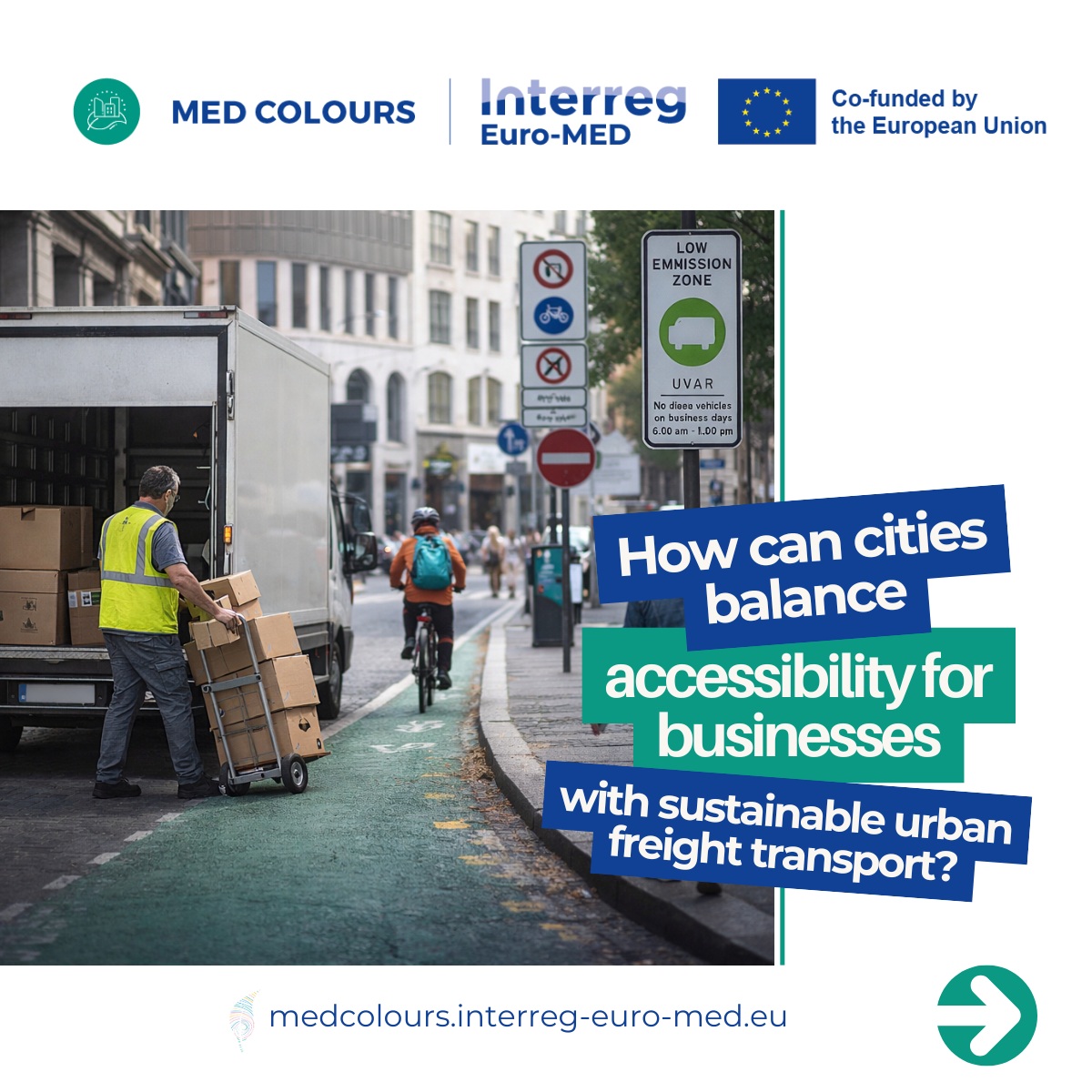

New episode of the MED COLOURS column dedicated to the topic of resilient and sustainable urban logistics. Once a month, we suggest articles, insights and studies of particular interest to the topics related to the project, with the aim of increasing knowledge related to the topics, and stimulating debate and knowledge exchange, which are essential ingredients for the achievement of our project goals.
This month’s focuse is: How can cities balance accessibility for businesses with sustainable urban freight transport?
Managing city access for logistics and service operators is a growing challenge for urban areas. Restrictions, regulations, and access rules are essential to reduce congestion and emissions, but they can also create barriers for businesses if not well designed.
On 28 January 2026, the European Commission’s Expert Group on Urban Mobility (EGUM) adopted a new report on “City Access for Businesses Challenges and Best Practices for Urban Freight Transport”. The report explores how cities across Europe are tackling this delicate balance. It highlights key challenges such as fragmented regulations, lack of harmonisation, and limited stakeholder coordination, while also showcasing best practices to improve efficiency, sustainability, and compliance. The analysis is structured around four main categories of challenges:
- Market access
- Zonal access
- Access to physical infrastructure
- Governance and stakeholder engagement
From access management schemes and Urban Vehicle Access Regulations (UVARs) to digital solutions and stakeholder involvement, the report provides actionable insights for policymakers aiming to design efficient, sustainable, and business-friendly urban logistics systems without compromising environmental goals.
🔍 Read the full report here: https://www.etp-logistics.eu/new-egum-report-on-city-access-for-businesses-challenges-and-best-practices-for-urban-freight-transport/
The MED COLOURS project builds on these insights by promoting innovative and sustainable urban logistics solutions across six European cities (Livorno, Cesena, Thessaloniki, Koper, Lisbon, and Lyon) through pilot actions and the development of Sustainable Urban Logistics Plans (SULPs). Our goal? Supporting cities in designing smart, coordinated, and low-emission logistics systems that work for both businesses and communities.